
Solar electricity refers to the process by which sunlight is converted into usable electrical energy through engineered systems. At the core of this process are semiconductor devices that respond to light by separating charge carriers, creating a direct current (DC) flow. That DC output is often conditioned by power electronics and, where needed, stored in electrochemical systems or exported to an electrical network. Components are arranged and sized to match expected sunlight, load profiles, and site constraints so that the system can supply electricity reliably under variable conditions.
Key technical elements include the light‑absorbing material, the electrical contacts that collect current, and the protective layers that reduce losses. Photovoltaic cells form modules that are mounted in arrays; these arrays are wired to inverters or converters that translate DC to alternating current (AC) for typical end uses. System design also accounts for orientation, tilt, shading, temperature effects, and wiring losses. Understanding these interactions clarifies how modules, inverters, and balance‑of‑system components work together to produce usable electricity.
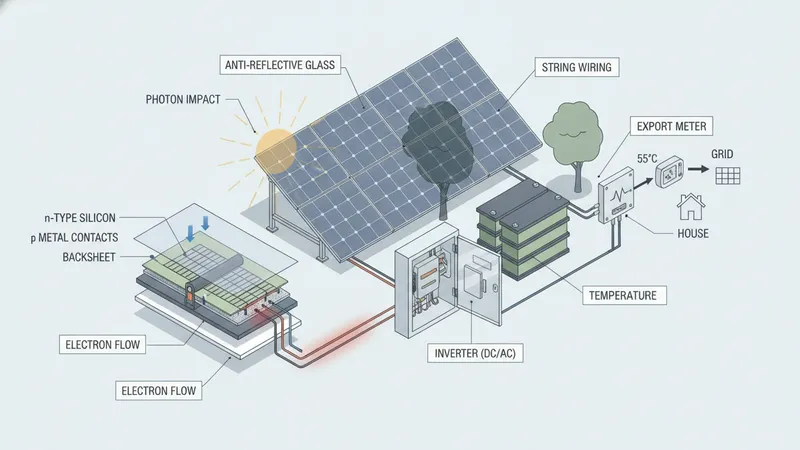
Comparing panel types may clarify tradeoffs that influence generation. Monocrystalline modules often have higher nominal conversion efficiencies per unit area, while thin‑film modules can perform relatively better in low‑light or high‑temperature conditions, depending on the technology. Panel electrical output is commonly rated under standard test conditions; real‑world yield typically differs because of site‑specific irradiance, module temperature, and spectral conditions. Designers may choose module types based on available area, expected incident sunlight, and cost constraints, acknowledging that performance can vary across operating conditions.
Power electronics play a central role in converting and maximizing energy output. String inverters aggregate multiple strings of modules and may include MPPT for each string, while microinverters perform MPPT at the module level, which can mitigate mismatch from shading or soiling. Power optimizers are DC‑side devices that perform MPPT per module and feed a central inverter. Each approach can affect system monitoring granularity, fault isolation, and long‑term maintenance considerations. Selection often reflects site layout, shading patterns, and maintenance preferences rather than absolute superiority.
Storage integration influences how solar generation is used across time. Lithium‑ion batteries are frequently used for their energy density and round‑trip efficiency, whereas lead‑acid systems may appear where initial cost constraints and specific application profiles make them suitable. Flow batteries offer long cycle life and decoupled energy/power scaling in some installations. Controllers and battery management systems manage charging patterns to reduce degradation, and system controllers can prioritize charging, discharging, or grid export depending on configuration and objectives.
Grid connection and islanding considerations determine how a solar system interacts with a wider electrical network. When tied to a grid, inverters must comply with grid‑interconnection standards and can perform functions such as anti‑islanding, voltage support, and frequency response in some systems. Off‑grid configurations require sizing of generation and storage to meet load and maintain reserve capacity. Regulatory and safety requirements commonly shape protective device selection, metering, and interconnection procedures, so designers typically account for local codes and utility interconnection rules.
In summary, converting sunlight into electricity combines light‑absorbing materials, electrical conversion hardware, storage when needed, and system controls to deliver usable power. Performance is shaped by module choice, power‑electronics architecture, storage technology, site conditions, and regulatory constraints. Each element may influence energy yield, reliability, and operational characteristics rather than guaranteeing specific outcomes. The next sections examine practical components and considerations in more detail.
Photovoltaic cells rely on semiconductor junctions to separate photo‑generated charge carriers; when light is absorbed, electrons and holes are created and driven apart by an internal electric field, producing a voltage. Cells are typically assembled into modules with protective glass, encapsulant, and a backsheet to guard against moisture and mechanical stress. Electrical connections among cells establish series and parallel arrangements to reach desired voltage and current levels. Thermal behavior also matters: cell temperature typically affects voltage and thus module output, so module materials and ventilation influence operational performance.
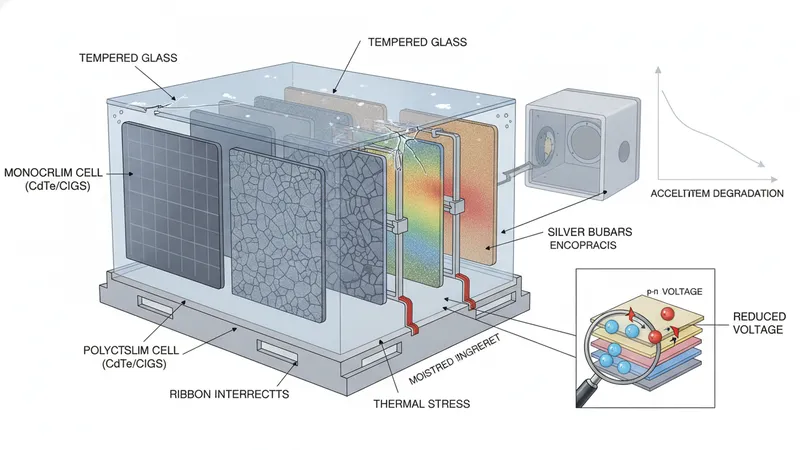
Different semiconductor materials and manufacturing methods yield distinct electrical and mechanical properties. Crystalline silicon remains widely used, with monocrystalline and polycrystalline variants differing in wafer structure and potential efficiency per area. Thin‑film technologies, such as cadmium telluride or copper indium gallium selenide, can offer advantages in specific environmental or mounting scenarios. Module degradation pathways may include ultraviolet exposure, moisture ingress, and thermal cycling; manufacturers typically perform accelerated testing, while system designers often account for long‑term performance declines when estimating energy production.
Module mounting and layout choices affect incident irradiance and maintenance. Fixed‑tilt arrays are common for simplicity, while single‑axis or dual‑axis trackers can increase energy capture by following the sun’s path, often at added mechanical and maintenance complexity. Shading from nearby trees, buildings, or soiling can create mismatch between cells and strings, reducing output; bypass diodes and module‑level power electronics are typical mitigations. Designers also consider wind and snow loads, corrosion resistance, and access for cleaning to support reliable generation over the system life.
Standardized test ratings (for example, power under standardized irradiance and temperature) provide a baseline for comparing modules, but actual yield often differs due to local climate, spectral conditions, and installation tilt or azimuth. Performance models typically use irradiance data and temperature coefficients to estimate expected generation over time. When planning installations, analysts may use historical solar resource data and simulation tools to project energy production while acknowledging that operational results can vary from modeled outputs.
Inverters convert DC electricity produced by photovoltaic modules into AC compatible with loads and electrical networks. They perform voltage and frequency shaping, MPPT, and protective functions such as anti‑islanding. Architectures vary: central inverters handle large arrays, string inverters manage groups of panels, and microinverters convert at the module level. Each approach may influence monitoring resolution, fault isolation, and the degree to which individual module performance affects overall system output. Power conditioning also includes filtering and surge protection to meet system and safety requirements.
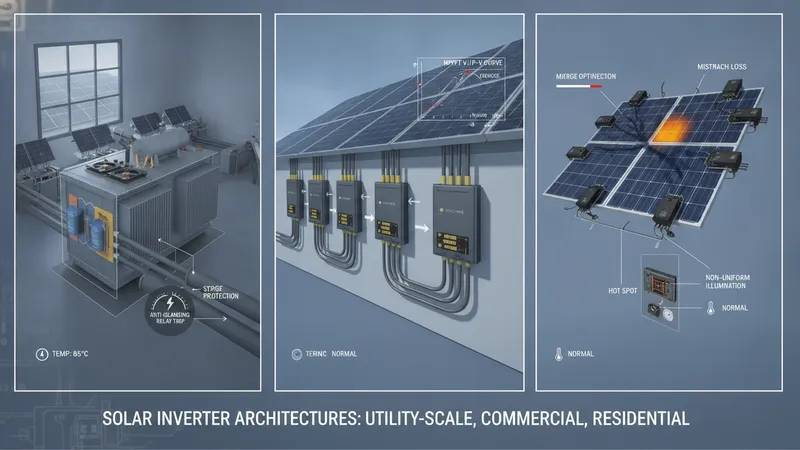
Maximum power point tracking algorithms are central to extracting usable energy under changing irradiance and temperature. MPPT strategies search for the voltage/current condition that yields the highest product of current and voltage for given environmental conditions. When modules experience non‑uniform illumination, module‑level MPPT (via microinverters or optimizers) can reduce loss from mismatch. Inverter thermal management and ambient temperature can affect efficiency; derating may occur at elevated temperatures, making ventilation and component selection important for consistent performance.
Grid‑interactive inverter features may include reactive power control, voltage regulation, and ramp‑rate limitations, which can support grid stability in some jurisdictions. Compliance with interconnection standards commonly dictates functions like anti‑islanding and may require specific response behaviors during frequency or voltage excursions. For off‑grid or hybrid systems, inverters often incorporate battery‑charging controls and waveform shaping suitable for local loads; these combined inverter‑charger units can coordinate charging priorities and load support without a grid connection.
Monitoring and diagnostics provided by inverters can inform maintenance and performance assessment. Data on energy production, voltage, current, and fault codes often allow operators to detect underperformance or component issues. Remote monitoring platforms may present module‑level or system‑level metrics depending on the power‑electronics architecture. While monitoring can aid troubleshooting, designers often weigh the tradeoffs among monitoring resolution, data handling complexity, and cost when selecting equipment for a given installation.
Energy storage systems paired with solar generation decouple production from consumption timing by storing excess generation and releasing it when needed. Storage is sized based on load profiles, desired autonomy, and depth‑of‑discharge considerations. Battery chemistry affects cycle life, energy density, safety characteristics, and operating temperature ranges. Charge controllers and battery management systems regulate charging currents and cell balancing to reduce degradation. Storage may be integrated for backup, load shifting, or smoothing of variable solar output, each application shaping sizing and control strategies.
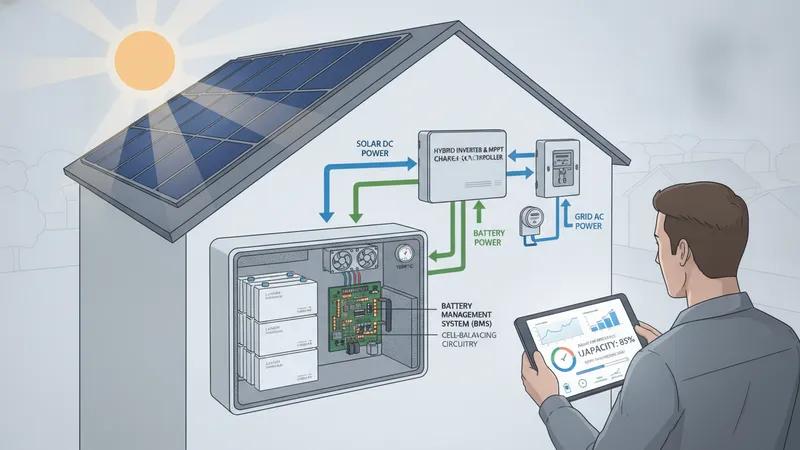
When integrating storage, round‑trip efficiency and usable capacity are typical planning metrics. Round‑trip efficiency describes energy retained after a full charge/discharge cycle and depends on converter losses and battery chemistry. Usable capacity accounts for recommended depth‑of‑discharge limits to preserve battery life. Thermal management and appropriate enclosures often matter, as temperature swings can accelerate aging. Designers commonly model storage dispatch strategies to align with household or facility demand patterns and to account for anticipated variability in solar generation.
Interfacing storage with the grid introduces additional considerations, such as islanding detection, synchronization, and complying with interconnection rules for energy export. In hybrid systems, controllers prioritize charging/discharging sequences: for instance, directing solar generation to loads first, then to storage, and finally to export, depending on configuration. Backup configurations may require transfer switches and coordination to ensure safety and continuity when the grid is unavailable. Systems intended for resilience often include redundancy and state‑of‑charge management to maintain critical loads during extended outages.
Economic and lifecycle considerations often shape storage selection and operational strategies. Batteries may have specified cycle lifetimes, calendar degradation rates, and warranty terms that inform total cost of ownership analyses. Maintenance needs, recycling pathways, and end‑of‑life handling are also relevant. Because technology and cost trajectories can change, planners typically model multiple scenarios to understand how storage performance and degradation can affect long‑term system behavior rather than assuming fixed outcomes.
System yield depends on irradiance levels, module orientation and tilt, soiling, shading, and temperature. Solar resource varies by location and time of year; resource assessment often uses historical irradiance datasets and may account for local weather patterns. Tilt and azimuth that optimize annual yield can differ from those that optimize instantaneous output or seasonal generation. Soiling and maintenance schedules can notably affect output in some climates, while shading from nearby objects can reduce string performance unless module‑level power electronics are used.
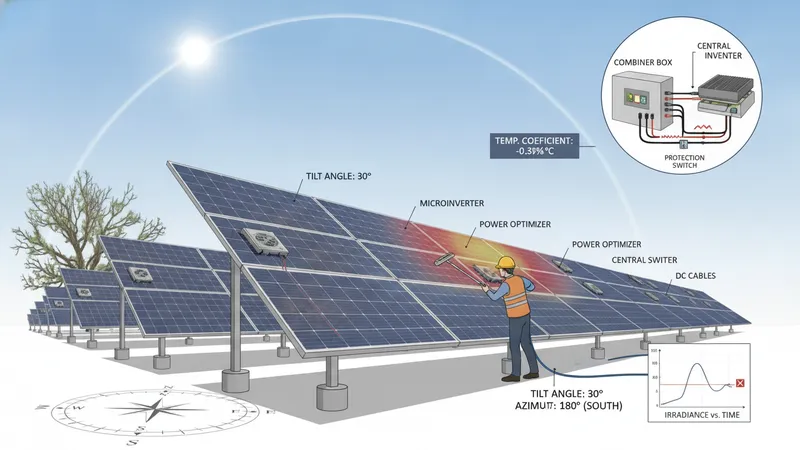
Electrical losses also influence delivered energy. These losses occur in module wiring, connectors, combiner boxes, and inverter conversion processes. Cable sizing and layout affect resistive losses, while protection devices and switches introduce small additional drops. Temperature coefficients capture how module voltage and current vary with temperature, and these coefficients are applied in production modeling to estimate realistic output under expected thermal conditions. Designers typically include conservative margins to account for these predictable losses.
Operation and maintenance practices can extend useful system performance. Periodic inspection of module integrity, connector condition, and mounting hardware helps identify degradation or damage. Firmware updates for power electronics can address bugs or add functions, while monitoring data may reveal trends that suggest corrective actions such as cleaning or replacement. Safety protocols for working on energized systems and procedures for isolating equipment are part of routine operational planning to reduce risk to personnel and equipment.
Long‑term performance projections often use degradation rates provided by manufacturers and historical field studies to estimate annual production decline. These projections are used for planning and comparison across design options, but actual outcomes can vary with installation quality, environmental exposure, and operational choices. Understanding the range of factors that affect generation helps stakeholders set realistic expectations and plan maintenance, monitoring, and potential component replacement over the system’s operational life.